Search is changing from a list of links into something much more interpretive.
A customer can still type a few words into Google and browse traditional search results, but that same person may now ask a detailed question in Google AI Mode, read an AI Overview, use ChatGPT Search to research a company or ask an AI system to compare several possible providers before ever visiting a website.
For businesses, this creates a new visibility question. It is no longer enough to ask whether your website ranks for a keyword. You also need to consider whether search and AI systems can find your information, understand what your organization knows, distinguish your company from other businesses and identify your website as a useful source when someone asks a relevant question.
That is the practical purpose of answer engine optimization, or AEO.
The important part is that AI search does not require businesses to abandon everything they know about SEO and start again. Google explicitly says that the SEO practices used to make websites discoverable in conventional search remain relevant to AI Overviews and AI Mode, and that there are no additional technical requirements or special AI-specific markup required to appear in those experiences.
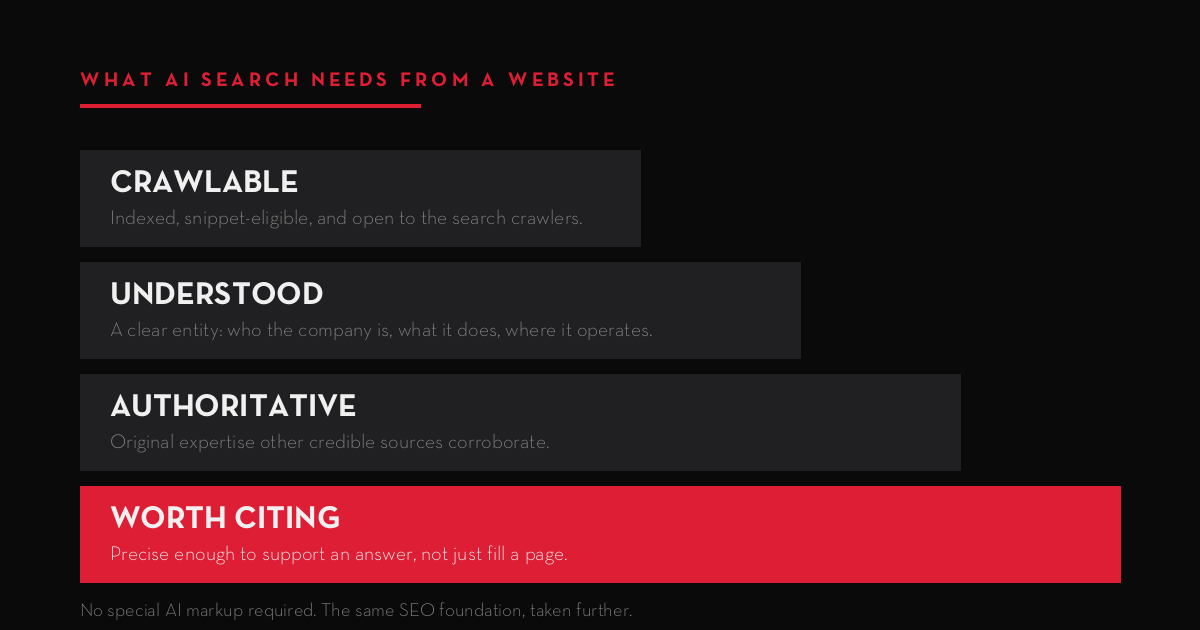
The foundation remains familiar. Your website needs to be accessible, understandable, useful, authoritative and connected to the larger digital identity of the business. What changes is the depth of the questions being asked and the way information can be assembled into an answer.
AI Search Needs to Find Your Website Before It Can Understand It
The first requirement for AI visibility is less glamorous than most discussions about AEO make it sound. The content has to be accessible.
For Google’s AI Overviews and AI Mode, a page must already be indexed and eligible to appear in Google Search with a snippet. Google says there are no additional technical requirements specifically for inclusion in its generative AI search experiences.
ChatGPT Search has its own discovery requirements. OpenAI says public websites can appear in ChatGPT search results and recommends allowing OAI-SearchBot to access content so that pages can be discovered, surfaced, cited and linked.
That makes crawlability a fundamental part of AI visibility.
A website can contain exceptional expertise and still be difficult for search systems to use if important pages are blocked through robots.txt, hidden behind authentication, inadvertently marked noindex or restricted by hosting, security or CDN configurations.
Technical SEO therefore remains part of AEO. Before worrying about how an AI system interprets your expertise, make sure it can actually reach the pages where that expertise lives.
Traditional SEO Is Still the Foundation of AI Search Visibility
There is a growing temptation to speak about SEO and AEO as though one has replaced the other. That is not what the major search platforms are saying.
Google describes its generative AI search experiences as being rooted in its existing Search ranking and quality systems. Its current guidance specifically states that SEO remains relevant to AI-powered search because AI features draw on content from the Search index and use retrieval systems to find useful, current web pages.
This makes sense when you consider the problem an AI search system is trying to solve.
A person asking, “What should I look for when hiring an engineering firm for a municipal infrastructure project?” is asking a more complex question than someone searching “engineering firm Edmonton.” The AI system may need to retrieve information about engineering disciplines, procurement considerations, project experience, risk, geography and other related subjects before assembling a useful response.
Google says AI Mode and AI Overviews can use a process it calls query fan-out, where several related searches are performed across different subtopics and data sources to develop an answer. This creates opportunities for useful websites to surface even when the original question does not resemble one conventional keyword phrase.
That is one of the most important shifts in search strategy. A website that demonstrates genuine depth around a subject can become relevant to many questions the business may never have targeted as individual keywords.
AI Systems Need to Understand Who the Business Is
Visibility in AI search depends on more than understanding an individual page. Search systems also need to understand the organization behind the information.
Who is this company? What does it do? Where does it operate? What industries does it serve? What expertise does it possess? How does this information relate to the rest of the organization’s digital presence?
A website should make those relationships clear.
Google recommends Organization structured data because it can help the search engine understand administrative and identity information about a company and distinguish one organization from another. Information such as the company name, website, logo, contact details, real-world locations and other business identifiers can all contribute to a clearer entity.
For local businesses, LocalBusiness structured data can provide additional information about a business and its locations.
Structured data is only one part of that picture. The visible website content should reinforce the same identity through clear About information, service pages, location information, leadership or author information, industry expertise, case studies and other evidence that helps establish what the organization actually represents.
The goal is consistency. A business becomes easier for search systems to understand when its website, business profiles, supporting content and broader digital presence all describe the same organization clearly.
Specific Expertise Is More Useful Than Generic Marketing Language
AI systems work particularly well with context. That makes vague business language increasingly limiting.
A company that describes itself as “an innovative leader providing trusted solutions and exceptional service” has communicated very little information that distinguishes it from thousands of other organizations.
A manufacturer that explains exactly what it produces, the materials it works with, the industries it serves, its certifications, production capabilities, geographic markets and technical expertise gives search systems substantially more information.
An engineering firm can identify its disciplines, project types, regulatory experience and sectors. A commercial real estate company can describe its asset classes, markets and development expertise. A technology company can explain the problem its platform solves, how the technology works and which organizations benefit from it.
This specificity helps prospective customers, traditional search engines and AI systems simultaneously.
AEO is therefore connected to positioning. The clearer a business is about what makes its expertise meaningful, the easier it becomes for digital systems to understand when that expertise should be surfaced.
Original Knowledge Gives AI Search Something Worth Finding
One of the strongest opportunities in AI search is also one of the oldest principles in content strategy: say something useful that is actually yours to say.
Google’s guidance on helpful content specifically asks whether a page provides original information, reporting, research or analysis, and whether it offers meaningful value beyond what already exists elsewhere.
That principle becomes particularly important when AI systems can summarize common knowledge quickly. If fifty websites contain essentially the same article about “five benefits of digital marketing,” there is little reason for any one of those pages to become especially important.
Original research is different.
A company can publish findings from a real audit, observations from customer work, analysis of an industry change, a detailed explanation of a technical process, lessons from completed projects, useful benchmarks, market data or a perspective developed through years of professional experience.
That material gives search and AI systems something distinctive to retrieve.
Our own audit of 20 Edmonton business websites is a good example of the principle. The value does not come from rewriting generic advice about homepage design. It comes from examining real businesses, identifying a recurring pattern and contributing an observation based on original work.
That is the kind of content that builds authority rather than simply adding another page to the internet.
Strong Content Answers Questions in Context
There is a misconception that AEO means turning every website into a giant FAQ.
Questions can certainly be useful because people increasingly search conversationally, but the objective is not to manufacture hundreds of short question-and-answer blocks. The objective is to provide complete information.
Someone researching the cost of a professional website may also need to understand why two websites with the same page count can have dramatically different budgets, what drives complexity, how integrations affect cost, how content strategy contributes to the project and what an organization should expect at different levels of investment.
A strong article can answer all of those related questions naturally within one coherent piece.
This matters because AI search systems are often resolving complex queries rather than matching a single phrase to a single paragraph. Google’s query fan-out approach, for example, can explore several related subtopics when developing an AI response.
Content depth therefore has strategic value when that depth is useful rather than padded. A page should leave the reader with a substantially better understanding of the subject than they had when they arrived.
Clear Structure Helps People and Machines Understand the Content
Strong prose and strong structure can coexist.
A well-organized website uses descriptive headings, logical sections, clear page titles, meaningful internal links and content hierarchy to help a reader understand where information lives and how ideas relate to one another.
Those same characteristics help search engines navigate and interpret the website. Google recommends making pages easy to find through internal links and ensuring that important information is available in textual form.
This is one reason internal linking should be strategic rather than decorative.
An article about website cost can naturally connect to website strategy, SEO, AEO, hosting or industry-specific website content. An article about Google Maps visibility can connect to local ranking and Google Business Profile management. An engineering website article can connect to relevant case studies, website strategy and B2B advertising.
Those connections help people continue their research while establishing relationships between subjects across the site.
Over time, the website becomes more than a collection of pages. It becomes a structured body of knowledge about what the organization does and understands.
Structured Data Helps With Understanding, but It Is Not an AI Ranking Trick
Structured data is useful because it provides search engines with explicit information about the content and entities represented on a webpage.
Organization, LocalBusiness, Article, Breadcrumb and other appropriate schema types can help Google interpret different kinds of content and business information. Google recommends that structured data accurately reflect the visible content on the page.
What structured data does not provide is a secret shortcut into AI answers. Google explicitly says businesses do not need special schema.org markup, special AI files or new machine-readable formats to appear in AI Overviews or AI Mode.
That distinction matters because every major change in search creates a market for tactics promising to “unlock” the new system.
The more durable approach is to use structured data for what it is actually designed to do: make legitimate information clearer to search systems. The content still has to deserve visibility.
Authority Is Built Beyond Your Own Website
A company can say almost anything about itself. Independent evidence gives those claims more weight.
Search systems have long used information from across the web to understand organizations, subjects and relationships. Google, for example, explains that it can gather business information from official websites, public web content, third-party data and user contributions.
That means digital authority is not confined to what appears on your own domain.
Relevant links, media coverage, professional associations, customer reviews, citations, industry directories, partner relationships, credible profiles and other legitimate mentions can all help establish that an organization exists within a larger ecosystem.
For businesses, this is where marketing, public relations, reputation, SEO and digital strategy begin to overlap.
An engineering firm that publishes strong technical content, appears in credible industry publications, has documented project experience and is referenced by relevant organizations gives search systems several kinds of corroborating evidence. A company that only describes itself as an industry leader on its own homepage provides considerably less.
Authority is strongest when other evidence supports the position the website is making.
Authorship and Expertise Matter More as Questions Become More Complex
Search engines increasingly need to determine not only what information exists, but why it should be trusted.
Google’s guidance on people-first content encourages clear authorship where readers would reasonably expect it and specifically recommends helping visitors understand who created content and what expertise sits behind it.
That does not mean every service page needs an elaborate author biography. It means expertise should be visible where expertise matters.
A technical article can identify the professional who contributed to or reviewed it. A legal or financial article can establish appropriate credentials. A company publishing original research can explain how the research was conducted. A case study can identify the nature of the work and the results achieved.
These details create confidence for the reader and useful context for systems trying to evaluate the credibility of the information. The more consequential or specialized the subject, the more valuable that context becomes.
AI Search Rewards Depth More Than Content Volume
Publishing frequently and building authority are not the same thing.
A website containing hundreds of shallow articles may have considerably less strategic value than a smaller body of genuinely useful content covering the subjects the organization knows deeply.
Google’s current helpful-content guidance specifically cautions against producing large amounts of content across many topics simply in the hope that some of it will attract search traffic. It encourages original, substantial content built primarily for people rather than content created to manipulate rankings.
This should influence how companies approach AI-era content strategy. The goal is not to generate an article for every imaginable question.
The stronger approach is to identify the subjects on which the organization deserves authority and build a coherent body of useful information around them.
For a manufacturer, that might include technical capabilities, materials, production processes, procurement issues and industry applications. For an engineering firm, it may include disciplines, project considerations, standards, risk and sector-specific expertise.
For Schif And The City, subjects such as website strategy, SEO, AEO, digital advertising, audience intelligence, business positioning and customer acquisition naturally belong within the same expertise ecosystem.
Depth reinforces identity.
AI Search Visibility Is Also About Being Worth Citing
Traditional SEO has often focused heavily on earning the click. AI search introduces another useful objective: becoming a source worth referencing.
When an AI-generated response uses outside web information, the ideal outcome is for your organization to be among the sources helping support the answer.
That does not mean artificially writing every paragraph as a quotable sound bite. It means creating information that is precise enough, useful enough and well-supported enough to contribute meaningfully to a larger answer.
Original statistics are useful. Clear definitions are useful. Detailed explanations are useful. Specific professional insight is useful. Strong comparisons and real-world examples are useful. Generic promotional copy contributes much less.
This is another reason content marketing and thought leadership are becoming increasingly intertwined with search visibility. The organization that teaches the subject clearly creates more opportunities to be associated with that subject.
AI Search Does Not Eliminate the Need for a Great Website Experience
Discovery is only the beginning.
A customer who encounters your company in an AI answer may still visit the website before making a meaningful decision. The site then needs to validate everything the search experience suggested.
Is the company credible? Does the website clearly explain the expertise that caused it to surface? Are there projects, customers, reviews, case studies or credentials supporting the position? Is the next step easy to understand?
Google continues to emphasize overall page experience as part of building successful search content, including mobile usability, security, Core Web Vitals and an experience where the primary content is easy to identify.
AI visibility cannot compensate for a website that fails the customer once they arrive. Search visibility and conversion strategy still belong in the same conversation.
Local Business Information Matters in AI Search Too
AI search is not limited to educational questions.
People also ask systems to recommend local companies, compare providers and identify businesses that meet particular requirements. That makes accurate business information increasingly important.
Google recommends keeping Business Profile information current as part of its guidance for AI search visibility, while Organization and LocalBusiness structured data can help establish business identity and real-world location information. OpenAI’s search products can also use location context when responding to local requests.
A business therefore benefits from having a coherent geographic identity.
An Edmonton-based organization can establish strong local relevance while its website builds subject authority across Canada, USA and international markets. The physical location establishes where the business exists; the content establishes how far its expertise can travel.
Those are different signals, and growth-oriented businesses need both.
Does Your Website Need Special AI Markup?
At least for Google’s current generative search features, the answer is no.
Google explicitly says there is no special schema, special AI file or additional machine-readable requirement necessary for appearing in AI Overviews or AI Mode. Existing SEO fundamentals and appropriate structured data remain the recommended foundation.
For ChatGPT Search, accessibility matters. OpenAI says website owners who want their content discoverable and eligible to appear in search results should allow OAI-SearchBot and ensure their hosting or content-delivery infrastructure does not block OpenAI’s published search crawler traffic.
That makes the technical audit fairly straightforward. Ensure legitimate search crawlers can reach the site, ensure the content is indexable where appropriate, use structured data accurately and devote the larger strategic effort to building information that deserves to be discovered.
Can You Measure Whether Your Website Appears in AI Search?
Measurement is improving.
Google introduced dedicated reporting for generative AI visibility in Search Console in 2026, providing website owners with greater insight into impressions from experiences such as AI Overviews and AI Mode. Google reported that this capability had rolled out worldwide by August 31, 2026.
ChatGPT referrals can also be measured. OpenAI says links from ChatGPT search automatically include a utm_source=chatgpt.com parameter, allowing website owners to identify referral traffic through analytics platforms.
Traffic is still only one measurement. A company should also watch whether branded searches are increasing, whether the right pages are earning visibility, whether leads reference AI-assisted research and whether the website is becoming associated with the subjects that matter commercially.
As AI search matures, measurement will continue to evolve. The strategic objective remains clearer: become easier to find for the questions the right customers are asking.
SEO and AEO Should Strengthen Each Other
SEO helps search engines discover, crawl, understand and rank web content. AEO extends that work by considering whether the content is sufficiently clear, authoritative and useful to contribute to direct answers and AI-assisted discovery.
The two disciplines overlap heavily. Technical accessibility helps both. Clear information architecture helps both. Original expertise helps both. Structured business identity helps both. Strong content, legitimate authority and useful internal linking help both.
The mistake would be treating AEO as a replacement for SEO or as a separate collection of tricks. The stronger approach is to build a website that search systems understand deeply enough to use in several kinds of discovery.
What Makes a Website Visible in AI Search?
A website becomes more competitive in AI search when the technology, content and authority surrounding the business tell a coherent story. The site should be crawlable and indexable, the organization behind it should be clearly established, and the content should demonstrate real expertise with enough depth to answer meaningful questions usefully.
Strong architecture and thoughtful internal linking help search systems understand how subjects relate across the site, while credible evidence on the website and across the broader web strengthens the authority of the organization and the information it publishes.
AEO works through the combined strength of these signals. Companies that build that evidence deliberately give search engines and AI systems more reasons to understand who they are, what they know and when their information belongs in an answer.
Want Your Business to Be Easier to Find in AI Search?
Schif And The City is an Edmonton-based marketing, advertising and digital firm serving clients across Canada, USA and international markets. Our work brings together website strategy, SEO, AEO, content, digital authority and advertising because modern visibility depends on much more than ranking one page for one keyword.
If your organization has substantial expertise but your website is not communicating enough of it to customers, search engines or AI-powered discovery systems, the opportunity begins with understanding what information needs to exist, how it should be structured and how the larger digital presence can support it.
Talk to Schif And The City about your search and AI visibility. Read more on the Schif And The City marketing blog.