For many businesses, Google Maps is one of the most commercially valuable pieces of digital real estate available. A prospective customer searching for an accountant, contractor, physiotherapist, lawyer, equipment supplier, restaurant, consultant or other local service may encounter map results before reaching a company’s website, and the information shown there can influence which businesses are considered, which websites are visited and which phone numbers are called.
For Edmonton businesses, that makes local Google visibility especially important in a competitive market where customers may be comparing businesses across neighbouring districts and communities. The same underlying principles apply in Calgary, Vancouver, Toronto, Denver and virtually any other market where local search plays a role in customer acquisition.
The first thing to establish is what “not showing on Google Maps” actually means, because several different problems can produce what appears to be the same result.
Your Google Business Profile may not be properly verified. Your location or service-area configuration may conflict with Google’s eligibility rules. Important information may be incomplete or poorly aligned with the searches you want to appear for. The profile may have a policy issue, your business may lack enough prominence to compete with stronger results, or your website may not be reinforcing the same subjects, services and locations as your Google profile.
There is also an important difference between a business that is genuinely missing from Google Maps and one that appears when searched by name but does not rank prominently for broader searches such as “commercial electrician Edmonton,” “physiotherapy clinic near me” or “corporate accountant.”
Those are different problems, and they require different fixes.
First, Check Whether Your Business Is Missing or Simply Not Ranking
Before changing anything, search for the exact name of your company in Google Search and Google Maps.
If your business appears when you search its name, the profile exists. Your issue is more likely to involve local search visibility than listing availability.
That distinction matters because Google does not rank local businesses according to one setting that can simply be switched on. Local results are influenced primarily by relevance, distance and prominence, which means Google considers how closely a business matches the search, how geographically appropriate the result is and how established or well known the business appears to be.
Location naturally changes the result. Someone searching from downtown Edmonton may see a different set of businesses from someone performing the same search in Mill Woods, northwest Edmonton or St. Albert. The same dynamic applies in Calgary, where a search from the Beltline may produce different results from one conducted in Seton or the northwest.
Local search is local by design.
If the profile cannot be found even when you search the exact business name, however, the first four fixes below deserve immediate attention.
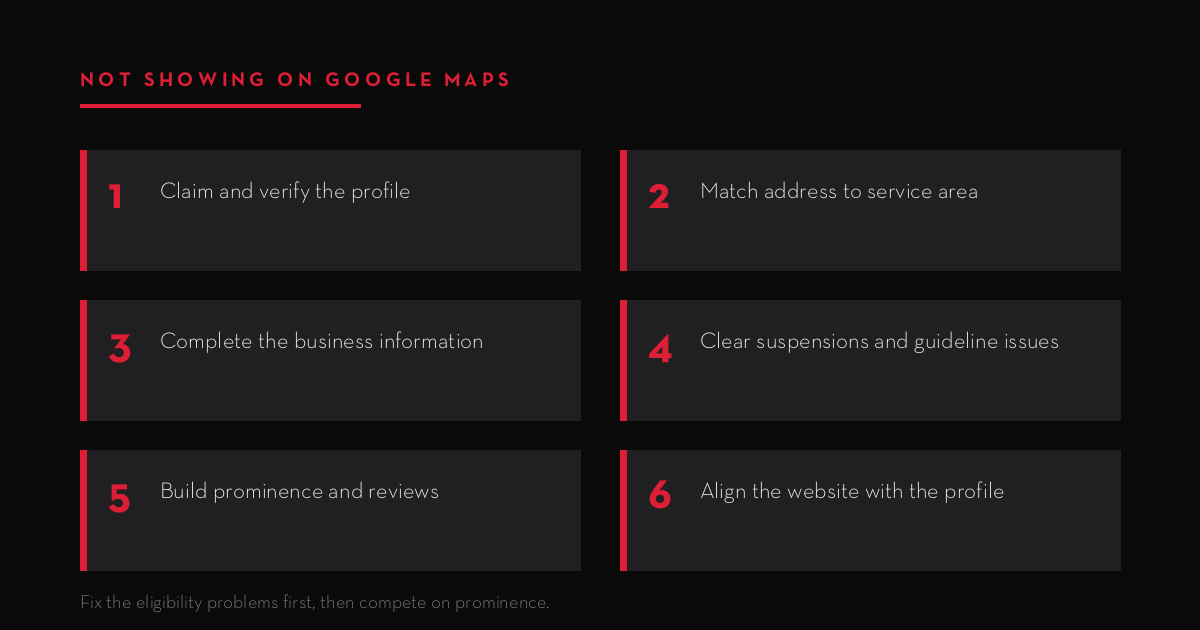
Fix 1: Claim and Verify Your Google Business Profile
A Google Business Profile is the business listing that supplies information to Google Search and Google Maps. Some business owners still refer to it as Google My Business or GMB, which was the platform’s former name.
Verification establishes that an authorized person represents the business and is one of the foundational steps in managing how the organization appears across Google.
Depending on the business and circumstances, Google may offer different verification methods. Businesses can encounter video, phone, email or other verification processes, and Google determines which methods are available for a particular profile.
Video verification has become familiar to many business owners, and it can require considerably more than demonstrating access to an email address. Google may ask for evidence that the business exists where claimed, that the operation is legitimate and that the person completing verification has authority to represent it.
For a storefront, office or other customer-facing location, that may mean being able to show permanent signage, the surrounding location and evidence of access to the business. For companies that travel to customers rather than serving them at a public location, the verification evidence may look different because the operating model itself is different.
If verification is pending, incomplete or has been requested again after an important profile change, resolve that before trying to diagnose more sophisticated SEO issues. An optimized profile has limited value while Google is still trying to establish whether the underlying business information can be trusted.
Fix 2: Make Sure Your Address and Service Area Follow Google’s Rules
The address field creates some of the most common Google Business Profile problems because a business address and a Google-eligible customer location are not always the same thing.
Google distinguishes between businesses that receive customers at their location, businesses that travel to customers and hybrid businesses that do both.
If customers genuinely visit your location during your stated business hours, the address may be displayed publicly. If you operate from an address where customers are not served, the correct configuration may instead be a service-area business with the address hidden from public display.
That distinction matters for contractors, cleaners, mobile technicians, consultants and other businesses whose work occurs primarily at customer locations.
A home-based plumber, for example, does not become a storefront simply because the company has a registered business address. The profile should reflect how customers actually interact with the business.
Virtual offices create another area of risk. An impressive downtown mailing address does not automatically qualify as an eligible Google Business Profile location, and businesses using coworking or virtual-office arrangements need to ensure the location genuinely meets Google’s requirements.
Businesses with multiple locations should be equally careful. Additional profiles should correspond to legitimate qualifying locations rather than being created simply to manufacture map coverage in more cities or neighbourhoods.
The objective is accurate geographic representation. For a company serving Edmonton and surrounding communities, that may mean maintaining a legitimate Edmonton office while accurately defining a wider service area. For a business with real operations in Edmonton and Calgary, each qualifying location can be represented independently. The same principle applies anywhere else the company operates.
Fix 3: Give Google Enough Information to Understand What Your Business Actually Does
A verified profile can still be difficult to find if Google has weak information about what the business represents.
Your business name, primary category, additional categories, services, address or service area, hours, website and other profile information collectively help Google interpret the organization.
The primary business category deserves particular attention because it helps define the type of business Google is evaluating. The most accurate category is usually more useful than selecting a broader label simply because it appears to contain an attractive keyword.
The same principle applies to the rest of the profile. An industrial electrical company should make that expertise understandable rather than presenting itself only as a generic contractor. A physiotherapy practice should accurately communicate the treatments and services it offers, while an accounting firm should provide enough information for Google and prospective clients to understand the nature of its practice.
Completeness matters because local search is fundamentally a matching problem. Google is trying to determine whether your business is relevant to what somebody requested, and clearer information gives the system more context for making that connection.
Accuracy should come before keyword manipulation. Adding search terms to a business name that are not genuinely part of the company’s real-world name creates risk rather than sustainable visibility.
Fix 4: Resolve Suspensions, Restrictions and Guideline Problems
Sometimes the visibility issue is more serious than optimization.
Google can suspend or disable Business Profiles that do not follow its guidelines for representing your business. When that happens, repeatedly editing fields or adding more content is unlikely to solve the underlying problem because the profile first needs to be brought into compliance and, where appropriate, appealed.
Areas worth reviewing include the business name, address, service-area configuration, eligibility of the location, duplicate profiles and whether the organization qualifies for a Google Business Profile in the first place.
Google generally expects eligible businesses to make in-person contact with customers during their stated hours, with defined exceptions. A purely online business therefore does not become eligible simply because a map listing would be commercially valuable.
If a profile has been suspended, reinstatement may require supporting evidence such as business registrations, licences, tax documents or utility records. Consistency between the supporting documentation and the information shown on the profile becomes particularly important.
This is one reason a Google Business Profile should be managed as business infrastructure rather than as an informal social account. Ownership, access, addresses and naming should be handled deliberately, especially when employees, agencies or outside consultants are involved.
Fix 5: Build the Prominence Google Is Looking For
Once the profile is eligible, verified and accurately configured, the question often changes from “Why am I not on Google Maps?” to “Why are these other businesses showing above me?”
This is where prominence becomes important.
Google evaluates how established and notable a business appears, using information from across the web as well as signals within the Business Profile itself. Reviews, organic search visibility, mentions, website authority and other evidence can all contribute to the broader picture.
In practical terms, your Google Business Profile does not exist in isolation. A business with a well-established website, substantial customer feedback, relevant online mentions, useful content and a clear operating history may give Google considerably more evidence than a comparable company with a minimally completed profile and very little presence elsewhere online.
Reviews deserve particular attention because they perform two jobs at once. They provide Google with additional evidence about the business while giving potential customers evidence about the experience of working with it. A steady history of authentic customer reviews can therefore contribute to both visibility and conversion.
Photos, accurate hours and current business information also help create a profile that reflects an active, established operation and gives customers enough information to make a decision.
There is no legitimate shortcut that guarantees the number-one Google Maps position. Local results vary according to the search, location, competitive landscape and Google’s ranking systems, so the stronger long-term strategy is to build the signals that make the business genuinely relevant and prominent.
Fix 6: Make Your Website and Google Business Profile Reinforce Each Other
This is the fix businesses frequently underestimate.
Google Maps visibility is not solely a Google Business Profile project. Your website can play a meaningful role in the broader local search ecosystem because Google evaluates the business using information gathered from multiple sources.
The website should clearly establish what the company does, where it is located or operates, which services it provides and what expertise it brings to those services.
That does not mean repeating a city name unnaturally throughout every paragraph. It means providing enough legitimate geographic and business context that there is little ambiguity about the organization.
A commercial contractor may show completed projects and describe the sectors it serves, which is one of the reasons so many business websites underperform. An engineering company may explain its disciplines, project experience and operating regions. A professional services firm may publish useful expertise related to the problems its clients encounter, while a multi-location company may maintain substantive information for each legitimate location.
This is also where local SEO connects with broader SEO and answer engine optimization. A detailed website gives search engines and AI-powered discovery systems more information about the relationships between your business, services, expertise, customers and geographic markets. A thin website paired with an optimized Google profile gives those systems considerably less context.
The two should tell the same story. Your Google Business Profile helps establish the company as a local entity, while the website provides the depth required to explain what that entity actually knows and does. When those pieces reinforce one another, local search becomes part of a larger digital authority strategy rather than an isolated map-listing exercise.
Why Does My Business Show on Google Maps by Name but Not for My Services?
This is one of the most common sources of confusion.
If you search the exact name of your business and find the profile, your company is already on Google Maps. The real question is why Google is not selecting the company prominently for a broader, non-branded search.
An accounting firm, for example, may appear immediately when someone searches its exact company name but rank much lower for “corporate accountant,” “accountant near me” or “business accountant Edmonton.”
That is a ranking issue rather than a listing issue. Google is comparing the relevance, distance and prominence of multiple businesses for that particular search. Your profile may therefore be functioning properly while stronger competitors are being selected for the broader query.
That requires a local SEO strategy rather than another verification attempt, and it helps to understand how Google actually decides local ranking.
Why Did My Google Maps Ranking Suddenly Drop?
Local visibility can change for several reasons, including changes to the profile, updates to business information, new competitors, evolving review profiles, website changes, location context and normal movement within Google’s ranking systems.
Business information can also be updated using data gathered from sources beyond the company itself, which is why profiles deserve periodic review rather than being treated as a one-time setup exercise.
A ranking change is most useful when approached diagnostically. Determine whether the profile changed, whether the website changed, whether competitors became stronger, whether the search location changed or whether a genuine eligibility or policy issue has emerged.
Understanding the cause is more valuable than applying a series of unrelated fixes.
How Long Does It Take for a Business to Appear on Google Maps?
A newly established or recently updated profile may not appear everywhere immediately.
New profiles and significant changes can require processing time, while major edits may also trigger additional review or verification. That makes it important to distinguish a normal processing period from a persistent visibility problem.
If the business information is accurate, the profile is verified and there are no policy concerns, allow Google’s systems reasonable time to process the information before repeatedly making further changes. Constantly altering important profile information while Google is evaluating it can make troubleshooting considerably more difficult.
Can a Service-Area Business Rank on Google Maps?
Yes. Eligible service-area businesses can maintain Google Business Profiles when they travel to customers rather than receiving customers at a public business location.
The configuration needs to accurately reflect that business model. Businesses that do not serve customers at their address should generally keep that address from public display and define the areas in which they provide service. Hybrid businesses that legitimately serve customers at both their own location and customer locations can configure their profiles accordingly.
This is especially relevant to trades, home services, mobile technicians and other businesses whose work occurs at customer locations.
A service area communicates where the business operates. It should not be treated as a substitute for physical locations the company does not actually have.
Local Google Visibility Is a Business Asset
For many businesses, local search occurs very close to the point of purchase. Someone searching for a nearby service often has an immediate need, and Google Maps can place a company in front of that person at precisely the moment they are deciding whom to contact.
That makes Google Business Profile management worth treating seriously. Verification, accurate location configuration, relevant business information, guideline compliance, customer reviews, digital prominence and a well-built website each contribute a different part of the local search picture. The strongest local presence emerges when those pieces reinforce one another rather than being managed independently.
Local authority also does not limit a company to one market. A business can establish strong Edmonton relevance while competing for customers elsewhere in Alberta, throughout Canada, in USA markets and internationally. Local SEO establishes legitimate geographic relationships, while deeper content, search authority, advertising and broader digital strategy allow the company to compete wherever its customers are.
That distinction matters for growth-oriented businesses. Being strongly associated with the city where you are based should strengthen your digital identity rather than define the outer boundary of your market.
Need Help Figuring Out Why Your Business Is Missing From Google Maps?
Schif And The City is an Edmonton-based marketing, advertising and digital firm serving clients across Canada, USA and international markets. Our digital work can bring together website strategy, SEO, AEO, Google Business Profile management, content, advertising and broader search visibility so that each part of a company’s online presence supports the others.
If your business is missing from Google Maps, appears only when searched by name or is consistently being outranked for commercially important local searches, the first step is determining which problem you actually have. Once the cause is clear, the right combination of profile management, local SEO, website strategy and broader digital authority becomes much easier to define.
Talk to Schif And The City about your Google visibility. Read more on the Schif And The City marketing blog.