When a business disappears from Google Maps, never appears in the first place or shows up only when someone searches its exact name, it is tempting to assume there is one setting somewhere that needs to be fixed.
Usually, there is more going on.
Google Maps visibility depends on whether Google recognizes the business as eligible, whether the Google Business Profile has been claimed and verified, whether the location is represented correctly, how well the business matches a particular search, where the person searching is located and how much evidence Google has that the business is established and relevant.
That means “my business isn’t showing up in Google Maps” can describe several different problems. A business that is completely absent from Maps needs a different solution from a business that appears by name but never shows for the services it wants to rank for.
Understanding which problem you actually have is the most useful place to begin.
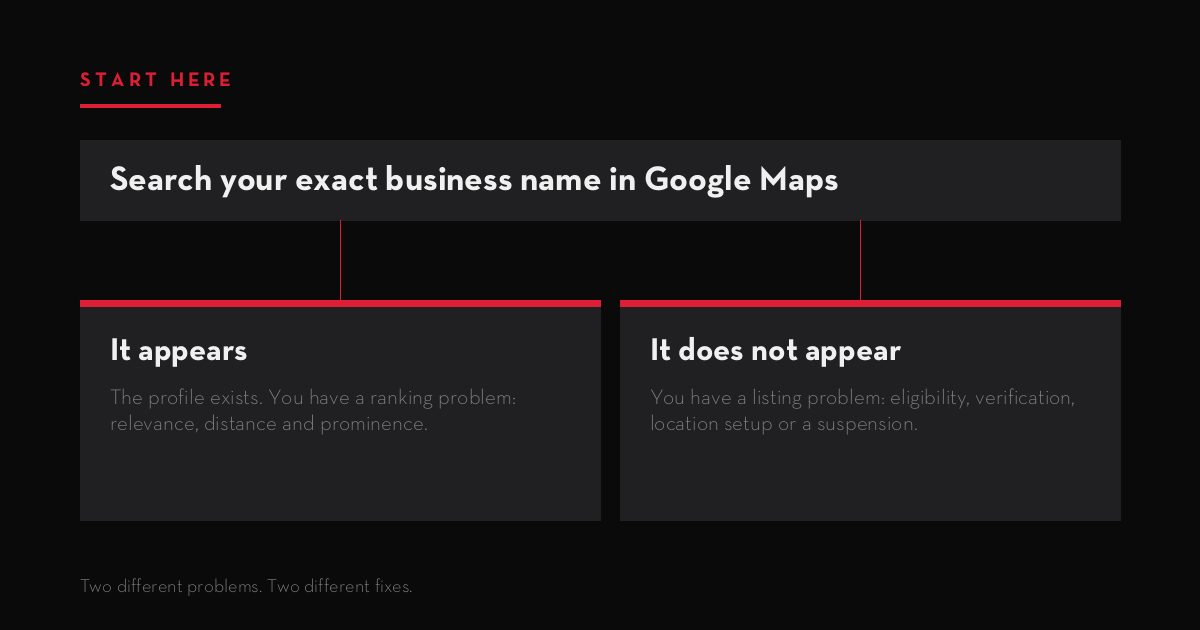
First, Find Out Whether Your Business Is Actually Missing
Search Google for the exact business name, then search for that same name directly in Google Maps.
If the business appears, your listing exists. The issue is more likely to involve ranking and local visibility than whether Google knows the company exists.
If the business does not appear at all, determine whether a Google Business Profile has ever been created or claimed for the company. Google allows eligible businesses to add or claim a profile at no charge, and a verified Business Profile can appear across both Google Search and Maps.
This distinction saves a great deal of unnecessary troubleshooting.
A business owner searching “plumber near me” and failing to find their company may conclude that the listing is broken, even though the profile appears immediately when the company name is searched. In that situation, the business is on Google Maps. Google is simply choosing other companies for that broader search.
That is a visibility problem, not a missing-listing problem.
Your Business Has to Be Eligible for a Google Business Profile
Google Business Profile is designed primarily for businesses that interact with customers in person during their stated business hours. There are defined exceptions, but a purely online business generally does not qualify simply because appearing on Maps would be commercially useful.
This matters because Google Maps represents real-world businesses and locations, not every company that happens to have a website.
A storefront, professional office, restaurant, clinic or other location where customers genuinely visit may qualify as a customer-facing business. A contractor, cleaner, mobile technician or other company that travels to customers may qualify as a service-area business.
The way the profile is configured should reflect the way the business actually operates.
A home address does not become a public storefront because the company is registered there, and a virtual office does not automatically create a qualifying business location. Google specifically restricts virtual offices for service-area businesses unless the location satisfies its staffing and operating requirements.
Accurate representation is more valuable than trying to manufacture geographic coverage.
Google Business Profile Verification Is More Than an Administrative Step
Google uses verification to establish that the person managing the Google Business Profile is authorized to represent the business.
The verification method available can vary depending on the company and profile. Once the business has been added or claimed and successfully verified, the owner can manage how its information appears across Search and Maps.
For many businesses, verification has become more rigorous because Google may need evidence that the business operates where claimed and that the person completing the process genuinely controls it.
That evidence can include the physical location, signage, business equipment, surrounding area or other operational details depending on the type of business and verification method Google provides.
If a profile remains unverified, is waiting for another verification step or has been asked to verify again after significant changes, resolve that issue before spending significant effort on ranking tactics.
Google first needs confidence in the business itself.
Your Address and Service Area Need to Match Reality
Location configuration is one of the areas where legitimate businesses can accidentally create problems for themselves.
Google distinguishes between storefront businesses, service-area businesses and hybrid businesses. A service-area business travels to customers and does not receive customers at its own address, while a hybrid business serves customers at its location and also travels or delivers to them.
If customers do not visit the business address, Google instructs service-area businesses to remove that address from public display and define the areas they serve instead. Eligible service-area businesses can specify cities, postal codes or other service areas within Google’s limits.
The service area should describe where the business actually works rather than functioning as a substitute for physical offices.
A contractor that legitimately serves several municipalities can represent that service area without pretending to maintain locations in each one. Conversely, a company with genuine qualifying operations in several cities may be able to maintain separate profiles for those real locations.
This distinction becomes increasingly important for businesses expanding into new markets. Geographic growth should be reflected by actual operations and accurate business information rather than by creating artificial map locations.
Showing Up by Name and Ranking for a Service Are Two Different Things
This is probably the most important distinction in Google Maps troubleshooting.
If someone searches your company name, Google already has a strong clue about which business they want.
A search such as “commercial electrician,” “family lawyer,” “industrial equipment supplier” or “physiotherapy near me” gives Google a much harder job. It has to decide which businesses among many possible choices are the most appropriate results for that user.
Google says local results are primarily influenced by relevance, distance and prominence. Relevance concerns how well a business matches the search, distance considers how far the business is from the searcher or location being searched, and prominence reflects how established or well known the business appears to be.
Those three factors explain why a company can have a perfectly legitimate Google Business Profile and still have limited Maps visibility for competitive searches.
The listing exists. The competition is happening somewhere else.
Relevance Starts With Helping Google Understand the Business
Google cannot confidently match a company to a search if the information describing the company is vague, incomplete or inconsistent.
Business categories, services, hours, website information, location details and other Business Profile fields all contribute useful context. Google specifically recommends keeping Business Profile information complete and accurate because stronger information helps its systems determine whether a business is relevant to a local search.
The primary category deserves particular attention because it helps define what kind of business Google is evaluating.
An industrial electrical contractor, corporate accounting firm, orthopedic physiotherapy clinic or commercial real estate brokerage benefits from giving Google precise information about what it actually is rather than relying on overly broad terminology.
The same principle applies to the website. A business website that clearly explains services, industries, expertise, locations, projects and customer needs creates far more useful context than one built around generic claims about quality, trust and excellent service.
That clarity supports customers, search engines and increasingly the AI-powered systems that interpret information about businesses.
Distance Is a Ranking Factor You Cannot Optimize Away
Businesses sometimes interpret changes in their Maps position as evidence that something has gone wrong when geography is simply doing what geography does.
Google considers the distance between a potential result and the person searching. If someone does not explicitly provide a location, Google uses the location information available to estimate what is nearby.
That means the same company can occupy very different Maps positions depending on where the search is performed.
A business may appear prominently to someone five minutes away and be much less visible to someone searching from the other side of a large metropolitan area. A competitor may outperform you in one neighbourhood while your company performs better in another.
There is no legitimate SEO technique that eliminates physical geography from local search.
Businesses with wider service territories therefore need to think beyond Maps alone. Strong organic search visibility, useful service and industry content, advertising, location strategy and broader digital authority can help reach customers outside the immediate geographic advantage of a single Business Profile.
Prominence Is Built Across the Web
Google Maps is connected to a much larger information ecosystem.
Google explains that prominence can be influenced by information it finds about a business across the web, including links and other signals, while review quantity and review scores can also influence local ranking. Organic search position is another factor, which means conventional SEO contributes to local visibility as well.
This changes the way businesses should think about Google Business Profile optimization. The profile matters, but the profile is not the entire strategy.
A company with a substantial website, useful expertise content, authentic customer reviews, relevant online mentions, established industry relationships and a recognizable market presence gives Google more evidence to work with than a company whose entire digital footprint consists of a minimally completed listing.
Reviews are particularly valuable because they sit at the intersection of visibility and persuasion. They contribute additional information about the business while helping prospective customers evaluate whether they want to make contact.
Prominence accumulates over time. It is part of building a stronger business presence, not simply filling in another profile field.
Your Website Helps Explain Your Google Business Profile
Google gathers business information from several sources, including information supplied directly by businesses, user contributions, licensed data and publicly available information such as content found on the company’s official website.
That makes the relationship between a website and Google Business Profile strategically important.
The company name, location, services, expertise and other important details should tell a coherent story across both properties. The website then has room to provide considerably more depth through service pages, industry expertise, project examples, educational content, team information and other evidence that helps explain the organization.
For a growth-oriented company, this can extend well beyond local SEO.
A manufacturer may be locally headquartered while selling throughout North America. An engineering company may maintain offices in a few cities while delivering projects across several regions. A technology company may have a physical headquarters and customers around the world.
Google Business Profile helps establish the company’s legitimate geographic relationships. The website can establish the much larger subject and market authority surrounding the business.
Those functions complement one another without requiring the business to pretend every customer market is a physical location.
Your Google Business Profile May Have Been Suspended or Disabled
Sometimes a profile that previously appeared disappears because Google has taken enforcement action.
Google can suspend or disable Business Profiles that do not follow its guidelines. Businesses that believe a profile should be reinstated can use Google’s appeal process after making sure the profile complies with the applicable rules.
The appeal process may allow supporting evidence such as official business registration, business licences, tax certificates or utility bills. Google advises that information such as the business name and address on supporting documents should match the profile being appealed.
When suspension is the issue, adding more keywords, photos or posts is not the first priority. The first priority is understanding why the profile was restricted and ensuring the underlying business information complies with Google’s requirements.
This is another reason Business Profile access, ownership and location information should be managed carefully. What looks like a simple marketing listing is also part of the digital identity Google maintains for the business.
Changing Your Business Name to Add Keywords Is Not a Sustainable Fix
When companies discover that local ranking is competitive, some begin looking for shortcuts.
One of the most tempting is adding services or city names to the Business Profile name even though those words are not part of the company’s real-world business name.
That may look like optimization, but Google’s business-representation guidelines require businesses to represent themselves consistently with the name used in the real world.
The stronger approach is to build relevance through the appropriate category, services, website content and wider digital footprint rather than turning the company name into a collection of search terms.
Search visibility built on accurate business information is far more durable than visibility built around a guideline violation.
More Service Areas Do Not Mean More Rankings
Another common misconception is that adding every possible city to the service-area settings will automatically make the business rank throughout all of them.
Service areas primarily help communicate where a service-area or hybrid business operates. Google still considers relevance, distance and prominence when selecting local results, so adding another city to a service area does not create a new physical location or guarantee stronger Maps visibility there.
This distinction is especially important for companies serving large territories.
A business may genuinely serve an entire province or several states while maintaining only one physical location. Its Business Profile can accurately represent its operating model, while website SEO, advertising and other digital strategies help reach customers throughout the larger market.
Maps should be part of that acquisition strategy rather than being asked to carry all of it.
What If Your Competitors Keep Showing Above You?
Once eligibility, verification, profile information and location setup are correct, competition becomes the central issue.
Compare more than star ratings. Look at how clearly competitors describe what they do, how many relevant reviews they have accumulated, the strength of their websites, how established their online presence appears, whether they publish useful expertise and how closely their business categories and services align with the search.
Then consider geography. A competitor appearing above you may simply be considerably closer to the person searching. Another may have stronger prominence signals, while another may provide Google with a clearer relevance match for that particular query.
Local SEO becomes more productive when it is treated as competitive analysis rather than a checklist. The objective is to understand why Google has more confidence in another result and then strengthen the legitimate signals surrounding your own business.
Google Maps Visibility Is Part of a Larger Search Strategy
For many businesses, Maps is extraordinarily valuable because local searches often happen close to a buying decision. Someone searching for a nearby professional, supplier, contractor, clinic or service company may be ready to call, visit or request information immediately.
That makes Maps visibility worth pursuing seriously, but it also makes it important to understand its limits. Local search is only one way customers discover and evaluate a company.
A business with growth ambitions may also need to compete in organic Google results, AI-assisted search, industry searches, paid advertising, referral research and the broader digital evaluation that happens after a prospect hears the company’s name somewhere else.
The strongest strategy connects those channels. A well-managed Google Business Profile helps establish local relevance. A strong website establishes greater depth and authority. Reviews build evidence. Search content expands discoverability. Advertising creates additional opportunities to reach audiences that local search alone may never capture.
Together, those elements create a much stronger digital presence than Maps optimization treated as an isolated exercise.
Why Is My Business on Google but Not Google Maps?
A company can appear elsewhere in Google Search without having a visible or competitive Maps presence.
Google may know about the organization through its website and other online sources while the business either lacks an eligible and verified Business Profile or has a profile that does not rank strongly for local searches.
The first step is therefore to establish whether an eligible Business Profile exists and whether it has been claimed and verified. From there, determine whether the issue involves eligibility, location configuration, enforcement or ranking.
The distinction matters because each problem has a different solution.
Why Is My Business Only Showing When I Search Its Name?
If your Google Business Profile appears when you search the company name but not when you search for the services you offer, the profile already exists.
The challenge is competitive local visibility. Google is evaluating how relevant the business is to the search, how close it is to the searcher and how prominent it appears relative to other possible results. It is worth understanding how Google decides local ranking before changing anything else.
Improving that position is therefore a local SEO and digital-authority project rather than a matter of simply creating another listing.
Can You Pay Google to Rank Higher in Maps?
Google states that there is no way to request or pay for a better local ranking.
Businesses can certainly advertise through Google, but paid advertising and organic Google Maps ranking are separate mechanisms. Advertising can create additional visibility while organic local rankings continue to be determined by Google’s local search systems.
For many companies, using both strategically can make sense. The important distinction is understanding what each channel is accomplishing.
The Real Question Is What Google Understands About Your Business
When a company struggles with Google Maps visibility, the most useful question is rarely whether somebody has completed every item on an optimization checklist.
The larger question is whether Google has enough accurate, consistent and credible information to understand the business, where it operates, what it does and why it should be considered a relevant result.
Eligibility and verification establish legitimacy. Accurate location information establishes geography. Business Profile information establishes relevance. Reviews, website authority and broader online evidence contribute to prominence, while the searcher’s own location influences which businesses are practical results.
Once those pieces are understood, Google Maps becomes much less mysterious. It becomes another part of how a business establishes its identity, expertise and market presence online.
Need to Understand Why Your Business Is Missing From Google Maps?
Schif And The City is an Edmonton-based marketing, advertising and digital firm serving clients across Canada, USA and international markets. Our work brings together Google Business Profile management, SEO, AEO, website strategy, content and advertising because search visibility is strongest when the different parts of a company’s digital presence reinforce one another.
If your business is absent from Google Maps, visible only by name or consistently being outranked for the searches that matter commercially, the first step is determining whether you have an eligibility, verification, location, relevance or authority problem.
Once the real issue is clear, the strategy becomes considerably easier to define. Talk to Schif And The City about your Google visibility. Read more on the Schif And The City marketing blog.