When several businesses offer the same service in the same city, Google has to decide which ones deserve the most prominent local positions.
That decision affects the businesses shown in Google Maps, the local results that appear within Google Search and, increasingly, the information customers encounter while researching companies across Google’s broader ecosystem.
For a business owner, local rankings can sometimes feel inconsistent. A competitor farther away may appear above you. Your company may rank well from one neighbourhood and barely appear from another. A business with fewer years in operation may outrank an established company, while another seems to dominate searches despite offering many of the same services.
There is a system behind those results.
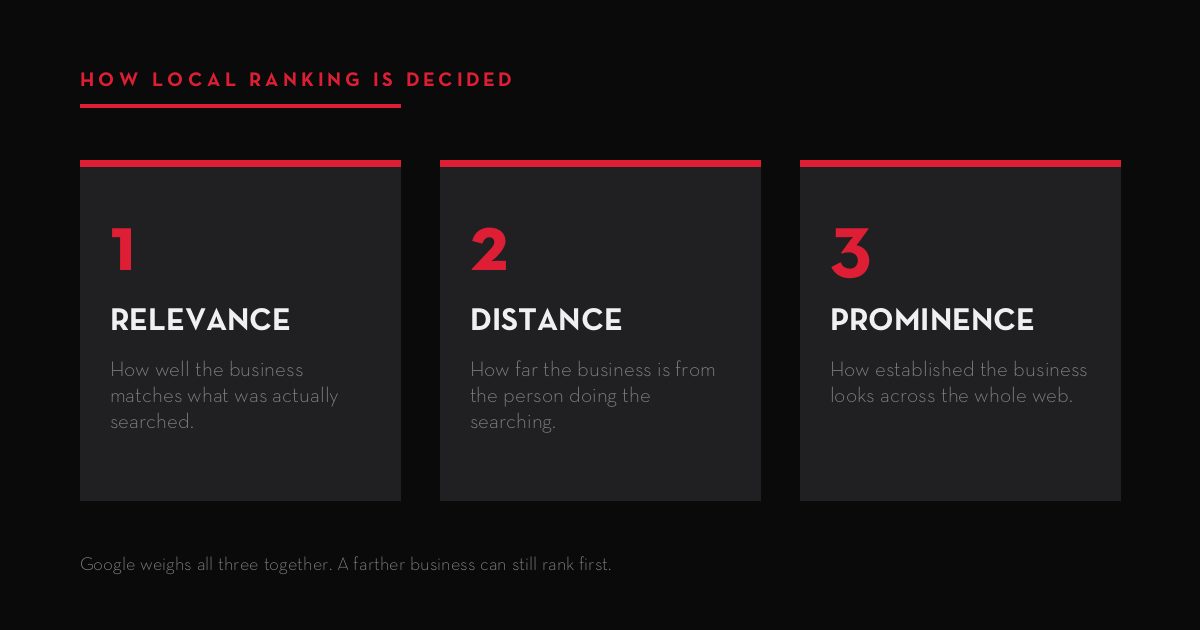
Google says local rankings are primarily determined through three factors: relevance, distance and what its current help documentation summarizes as popularity, then describes in more detail as prominence. Together, these signals help Google determine which businesses are the strongest match for a particular person, search and location.
Understanding those three factors changes local SEO from a collection of tactics into something much more useful: a strategy for helping Google understand what your business is, where it belongs and why it deserves consideration.
Local Ranking Starts With the Search, Not the Business
A local ranking does not exist in isolation.
Your business does not simply hold position three, seven or twelve on Google Maps in the same way a store occupies a fixed address. The result changes according to what someone searches, where that person is located and which businesses Google believes are most appropriate for that particular search.
A commercial electrician may rank strongly for one industrial electrical query and much lower for another related service. A physiotherapy clinic may appear prominently for searches conducted nearby but become less visible as the searcher moves across the city. An accounting firm may rank well for its business name while facing much stronger competition for a broad search such as “corporate accountant near me.”
This is why searching for your own company once and treating that result as your definitive Google Maps position can be misleading.
Local ranking is contextual. Google is continuously trying to answer a more specific question: which nearby businesses appear to be the strongest match for this person right now?
Relevance: Does Google Understand What Your Business Actually Does?
Relevance is the connection between the search and the business.
Google describes relevance as how well a Business Profile matches what someone is searching for and recommends providing complete, detailed business information to help its systems understand the company and match it to relevant searches.
That sounds straightforward, but it reaches much further than inserting a keyword into a profile.
Google needs to understand what type of business you operate, the services you provide, where you provide them and how those services relate to what someone is asking for.
The Business Profile contributes important information through categories, services, location, hours, attributes and other profile details. Your website can add considerably more context by explaining your expertise, industries, capabilities, projects, locations, customer needs and the subjects around which the business has genuine authority.
Consider two engineering firms. One website describes the company simply as an experienced engineering consultancy providing innovative solutions. Another clearly explains its civil, structural and municipal engineering disciplines, the types of infrastructure projects it completes, the sectors it serves and the geographic regions in which its team works.
The second business gives Google substantially more useful information about when it may be relevant.
The same applies to manufacturers, contractors, technology companies, healthcare practices, professional services firms and virtually every other category of local business.
Specificity helps customers understand the company, and it helps search systems do the same.
Your Business Category Matters Because It Defines the Starting Point
One of the most influential pieces of information inside a Google Business Profile is the business category.
Categories help Google understand what kind of business it is evaluating. A company should therefore choose the category that most accurately reflects what it actually is rather than treating category selection as a place to chase the largest search phrase.
This distinction can be significant. A specialized contractor may technically fit within several broad categories, but a more accurate primary category can give Google stronger context about the business’s real-world function. Additional categories can then provide further information where they genuinely apply.
The objective is not to make the profile look relevant to everything. It is to make the business unmistakably relevant to the right things.
That philosophy extends throughout local SEO. A company that clearly owns a specific area of expertise can often build a much stronger digital position than one that tries to describe itself as everything to everyone.
Distance: Why the Best Business Does Not Always Rank First
Distance is the factor businesses have the least ability to influence directly.
Google considers how far each potential result is from the person searching. When the searcher does not explicitly provide a location, Google uses the location information available to estimate where that person is.
This means two customers searching the same phrase can receive different local results simply because they are standing in different places.
A business located near downtown may perform strongly for searches made nearby while appearing much lower for someone several neighbourhoods away. In a large metropolitan area, those differences can become substantial.
This also explains why a competitor farther from your office can sometimes appear above you.
Distance matters, but Google weighs it together with relevance and prominence. Google explicitly notes that its systems may decide a business farther away is a stronger match and rank it above a closer option.
That is an important principle because it prevents businesses from reducing local SEO to geography alone. You may not be able to change where the searcher is standing, but you can strengthen the other reasons Google might consider your company particularly relevant and authoritative.
Service Areas Do Not Erase Geography
Service-area businesses sometimes assume that adding more cities or communities to a Google Business Profile will cause the company to rank equally throughout all of them.
That is not how local ranking works.
A service area helps represent where a business operates, but it does not create a physical presence in every city listed. Google still evaluates the search according to relevance, distance and prominence.
A contractor may genuinely serve customers across an entire metropolitan region while ranking more strongly near its actual base of operations. A company serving multiple cities may therefore need a broader acquisition strategy that combines Google Maps visibility with organic search, useful location and service content, paid advertising and other channels.
This matters particularly for growth-oriented businesses. Local search can provide extraordinary visibility around legitimate geographic relationships, but a company serving a large territory should not expect one Business Profile to carry the entire marketing strategy.
Prominence: How Established Does the Business Appear?
The third major factor is what Google describes in detail as prominence, meaning how well known or established a business appears.
Google says this assessment can draw on information including how many websites link to the business and how many reviews it has, while more reviews and positive ratings can contribute to stronger local rankings.
This is where local SEO connects to the rest of a company’s digital presence.
A Google Business Profile may be an important local asset, but Google does not understand the business solely through the information entered into that profile. Google says Business Profile information can also be compiled from publicly available web content, licensed third-party data, user contributions and Google’s own interactions with a business or place.
The wider digital footprint matters.
A company with a substantial website, meaningful customer reviews, legitimate online mentions, useful content, established business relationships and a recognizable presence in its market gives search systems more evidence than a company whose online identity consists primarily of a basic Business Profile.
Prominence, in that sense, is not simply another field to complete. It is accumulated evidence.
Reviews Matter, but Their Value Goes Beyond the Star Rating
Reviews are one of the most visible local-search signals because customers and businesses can see them directly.
Google confirms that review quantity and positive ratings can contribute to local ranking, and it encourages businesses to respond to customer feedback.
From a business perspective, their value is even broader. Reviews can help a prospective customer understand what the company is actually known for. Patterns in customer language may reinforce particular services, experiences, capabilities or attributes, while thoughtful responses show that the business is active and engaged.
This is why a genuine review strategy is more valuable than periodically asking for a burst of ratings when somebody notices a competitor has more.
Reviews should accumulate naturally as part of the customer experience. A strong review profile becomes evidence of an operating business with a history of serving real people, while also helping prospective customers make a more confident decision.
Your Website Is Part of Local Ranking
One of the most persistent misconceptions around local search is that ranking in Google Maps is primarily a Google Business Profile exercise.
The profile matters enormously, but the website matters too.
Google says it sources business information from publicly available information, including content crawled from official business websites.
Your website therefore has an opportunity to explain the organization with far greater depth than a Google Business Profile can provide.
A manufacturer can describe production capabilities, certifications, industries served and project experience. An engineering firm can demonstrate technical disciplines and completed work. A commercial real estate group can explain its portfolio and market expertise. A professional services firm can publish detailed insight into the problems its clients face.
Those elements contribute to a clearer digital identity, and they usually begin with what the homepage leads with. The stronger the relationship between the information on the website and the information in the Business Profile, the easier it becomes for search systems to understand who the company is, what it does and where it belongs.
Organic SEO and Local SEO Reinforce Each Other
Local SEO and traditional organic SEO are often treated as separate disciplines because they can produce different types of Google results.
In practice, they overlap. Google’s own local-ranking guidance explains that information from the wider web contributes to prominence.
This means a business strengthening its website architecture, content quality, authority and overall search presence may also be strengthening the digital evidence surrounding its local entity.
A company that becomes a meaningful source of information within its field creates more than keyword relevance. It develops the kind of subject authority that also makes a website usable in AI search.
That can be particularly important for businesses operating locally while selling across larger markets. An Edmonton manufacturer may need strong local entity signals while competing for buyers across Canada and USA markets. A technology company may have a physical headquarters in one city while serving customers internationally. An engineering firm may maintain several offices while delivering projects across a much larger geographic territory.
Local SEO establishes where the business has legitimate geographic relationships. Broader SEO establishes what the organization knows and where its expertise can compete. The strongest digital strategies understand both.
Complete Business Information Gives Google Better Evidence
Google recommends maintaining complete and accurate Business Profile information and specifically identifies details such as address, business hours, business category and other relevant attributes.
Completeness should not be confused with stuffing every available field with marketing language. The objective is clarity.
If Google has accurate information about what kind of business you operate, when you are open, where you are located, what services you provide and how customers can interact with you, its systems have a stronger foundation for evaluating relevance.
That information also helps customers. Local SEO often works best when the same improvements serve both the algorithm and the person using it. Clear hours reduce uncertainty. Accurate categories improve matching. Current photos help customers understand the business. Useful service information helps people determine whether the company can solve their problem.
When optimization improves the customer experience at the same time, it is usually moving in a productive direction.
Google Can Use Information You Did Not Add Yourself
A Google Business Profile is not necessarily composed only of information entered by the company.
Google says it can compile business information from public web content, third-party licensed data, users and its own interactions with local places. It may also update Business Profile information when other sources indicate that existing details are inaccurate or outdated.
That makes consistency across the wider web valuable.
Your official website should clearly represent the same organization shown in the Business Profile. Important business details should be current, and major changes to location, naming or operating structure should be managed thoughtfully.
The digital identity of a business becomes stronger when credible sources broadly agree about what that business is.
Can You Pay Google for Better Local Rankings?
Google is explicit on this point: businesses cannot request or pay for a better organic local ranking.
Advertising can certainly place a business in paid positions across Google products, and for many organizations paid search can be an important acquisition channel. Paid advertising and organic local ranking, however, are different systems.
This distinction matters strategically. A business does not need to choose between local SEO and advertising as though one invalidates the other. Paid media can create immediate reach for commercially important audiences and searches, while local SEO builds a longer-term base of relevance and authority.
The strongest mix depends on the business, competition, geography, customer value and growth objectives.
Why Does a Competitor Farther Away Rank Above You?
This is where the three-factor model becomes especially useful.
A farther competitor may be more relevant to the exact search. Its digital presence may provide stronger evidence of the specific service being requested. It may have greater prominence through reviews, links, website authority or broader market recognition.
Google weighs these factors together rather than ranking purely according to who is closest.
That means the most productive question is rarely, “Why is Google favouring them?” A stronger question is, “What evidence does Google have that makes this business a better result for this particular search?”
That framing turns frustration into competitive intelligence. Review the competitor’s categories, services, website, specialization, content, reviews and broader digital footprint. Examine where the search is being performed and whether geography gives the competitor an advantage.
Then determine which elements of your own digital presence can legitimately become stronger.
Why Do Local Rankings Change From One Part of a City to Another?
Distance creates an inherently geographic search environment.
Someone searching from the north side of a city may receive a meaningfully different set of local results from someone conducting the same search downtown or in the south. Even when both people use identical search language, their locations can change which businesses Google considers practical choices.
This is why local ranking reports need context. A single ranking captured from one location does not represent an entire city. Businesses evaluating local visibility should think in terms of geographic patterns rather than one universal position.
For companies with multiple legitimate locations, each location can develop its own geographic relationship with the surrounding market. For service-area companies operating from one base, other channels can help expand visibility farther into the territory.
What Actually Improves Local Rankings?
The answer becomes much clearer when viewed through Google’s three main factors.
Improve relevance by making the business easier to understand. Maintain an accurate Business Profile, select appropriate categories, represent services clearly and build a website with enough depth to establish genuine expertise.
Respect distance as a structural part of local search rather than trying to manipulate it. Build a geographic strategy around legitimate locations, actual service areas and the wider channels available for reaching customers beyond the strongest Maps radius.
Build prominence by developing a stronger business presence. Earn authentic customer reviews, create useful website content, strengthen organic visibility, attract legitimate mentions and links, and give customers reasons to talk about the organization.
None of these are isolated tricks. Together, they create better evidence.
Local Ranking Is Really a Question of Confidence
Google is trying to make a decision on behalf of the person searching.
Is this business relevant to what they asked for? Is it geographically appropriate? Is there enough evidence that the company is established and credible compared with the other available choices?
Seen that way, local SEO becomes much easier to understand. The objective is not to convince an algorithm through clever wording. It is to build a clear, consistent and credible digital representation of a real business so that Google has strong reasons to select it when the right customer searches.
That same work tends to improve the experience for people as well. Customers benefit from clearer service information, better evidence, stronger reviews, accurate locations and useful expertise. Search systems benefit from the same clarity.
Local Visibility Should Support the Larger Business Strategy
Google Maps can be extraordinarily valuable, particularly for businesses whose customers search locally and are ready to make contact.
It should still be understood as one part of a larger acquisition system.
A strong local presence can help customers discover the business. A strong website can help them understand it. Useful content can build expertise and search authority. Advertising can reach audiences beyond the limits of organic visibility, while analytics can help the company understand which channels actually contribute to customer acquisition.
For a growth-oriented organization, those elements should reinforce one another.
A business can rank strongly in its home market while selling throughout Canada, USA and international markets. Local authority establishes a credible geographic foundation, while broader search, content and advertising strategy allow the organization to pursue opportunity wherever the right customers exist.
Want to Understand What Is Driving Your Local Rankings?
Schif And The City is an Edmonton-based marketing, advertising and digital firm serving clients across Canada, USA and international markets. Our work can bring together Google Business Profile strategy, local SEO, broader SEO and AEO, website strategy, content and advertising so that local visibility supports the larger commercial objectives of the business.
If your company ranks strongly for some searches and disappears for others, or competitors consistently appear above you despite offering similar services, the answer usually becomes clearer once relevance, distance and prominence are evaluated together.
Understanding what Google sees is the first step toward giving it stronger reasons to choose your business. Talk to Schif And The City about your local search visibility. Read more on the Schif And The City marketing blog.