There are plenty of ways to evaluate a business website. Page speed, technical SEO, accessibility, mobile usability, search visibility, conversion rates and user experience can all reveal important information about how effectively a site is performing.
For this review, we wanted to examine something more fundamental: when a prospective customer lands on an Edmonton business website for the first time, does the opening experience give that person a compelling reason to choose this company?
In September 2026, we reviewed 20 Edmonton business websites across professional services, healthcare, commercial construction, industrial supply and B2B services. The businesses were selected through ordinary local search results rather than chosen because we already knew something about their websites, and we reviewed the publicly visible homepage experience available to any prospective customer.
We used the same basic questions throughout the review. Could a visitor quickly understand what the company does, who it serves, what makes it meaningfully different, what evidence supports that position and what the visitor should do next?
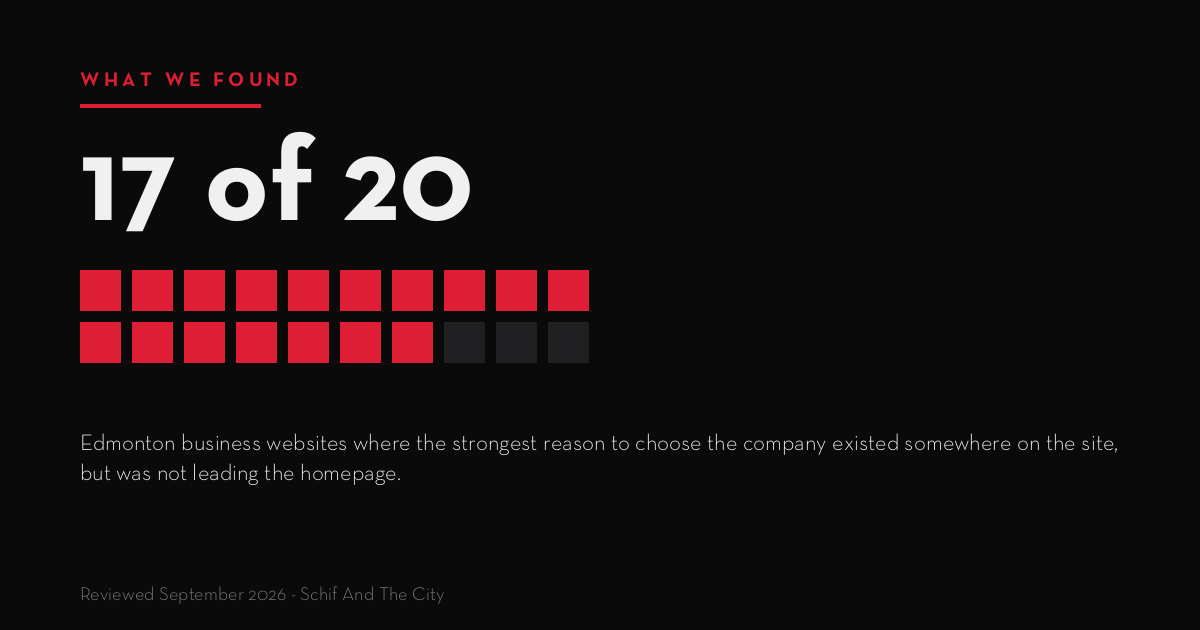
Seventeen of the 20 websites shared the same issue: their strongest reason to choose them existed somewhere on the website, but it was not leading the conversation. In many cases, the business had impressive experience, specialized knowledge, strong reviews, a clear industry niche or meaningful evidence of its capabilities, yet the homepage opened with language that could have belonged to almost any credible competitor.
The Recurring Problem Was Message Priority
Most of the businesses we reviewed had genuine strengths, and in several cases those strengths were substantial. Some had been operating for decades, some had accumulated hundreds of customer reviews, some had highly specialized expertise in particular industries, and others had strong client histories, certifications, unusual service models, deep local roots or capabilities that would clearly matter to a buyer.
The issue was rarely an absence of substance. We often found the strongest material after scrolling farther down the homepage, exploring service pages or reading an About section, while the opening message relied on familiar language about quality, trust, experience, personalized service, expertise, customer satisfaction or commitment to clients.
Those qualities matter because customers expect them from any serious organization, which is exactly why they cannot carry a business website on their own. The greater strategic opportunity is to move beyond expected qualities and give the customer a specific reason to prefer one company over another.
A visitor deciding between three Edmonton accounting firms gains relatively little from learning that each provides professional and reliable service. A buyer comparing commercial contractors expects every qualified contender to care about workmanship and quality, just as a patient looking for physiotherapy expects the clinic to provide thoughtful, individualized care.
The decision becomes more interesting when one accounting firm can point to decades of specialized tax-planning experience, one contractor has deep experience within a particular class of commercial project, or one clinic can support its position with hundreds of reviews and a clearly defined clinical approach. Specificity gives the customer something meaningful to remember and something useful to compare.
Many of These Websites Were Already Quite Strong
One of the more useful findings from the audit was that the recurring issue had very little to do with whether the websites were attractive or functional. Several were modern, organized and rich with useful information, while others had clearly invested in search engine optimization, detailed service pages, project galleries, FAQs, testimonials or conversion tools.
That makes the pattern more commercially relevant. A business website can be perfectly capable and still leave meaningful value on the table when the site gives similar weight to everything the company wants to say instead of prioritizing what the customer most needs to understand.
Business website strategy is partly an exercise in deciding what deserves prominence. The strongest proof should receive more attention than generic reassurance, the most commercially valuable specialty should be easier to discover than background company information, and the clearest competitive advantage should appear before a visitor has to search for it.
A business website has limited time to establish relevance and preference. The opening experience should use that time to help the right visitor understand why the organization deserves serious consideration.
Your Strongest Differentiator Should Be Difficult for a Competitor to Borrow
There is a simple positioning test that can reveal a great deal about a homepage. Take the company name out of the headline and replace it with the name of a direct competitor; if the sentence remains equally believable, the message is probably describing the category rather than the company.
Phrases such as “quality service,” “solutions you can trust,” “experienced professionals,” “committed to excellence” and “personalized solutions” can all be true. They become much more persuasive when they are supported by something specific to the organization.
An engineering firm might have unusual expertise in a particular class of infrastructure project. A manufacturer may have a production capability, certification or delivery advantage that materially changes a procurement decision, while an oil and gas services company may have specialized equipment, geographic reach or a safety record that carries meaningful weight with a buyer.
A technology company may solve a complex problem in a distinctly different way, while a commercial real estate company may have a portfolio, market concentration or development expertise that immediately establishes credibility. Those are positioning assets, and the website should treat them accordingly.
The Homepage Does Not Need to Say Everything. It Needs to Say the Right Things First.
One reason homepages become generic is that organizations try to satisfy too many internal priorities at once. Every service needs a mention, every department has something important to communicate, someone wants the mission statement included, someone else wants the company history, and search considerations introduce another layer of topics that need to be represented.
A strong information architecture can accommodate all of those needs, but the homepage has a more specific responsibility. Its first job is orientation, which means helping the visitor understand where they have arrived, what the organization does and whether it is relevant to them.
The next job is preference. The visitor should encounter enough substance to understand why this company deserves consideration, followed by evidence such as experience, results, projects, credentials, reviews, specialization or other forms of proof that make the position credible.
From there, the site needs progression. The visitor should have a logical next step based on the reason they arrived, whether that means learning more about a service, reviewing project experience, requesting a consultation, exploring a capability or contacting the company directly.
That progression may sound straightforward, but achieving it often requires considerably more business thinking than website design alone. The structure needs to reflect both how the organization works and how customers evaluate it.
This Matters for SEO, and It Matters Even More as AI Changes Discovery
Generic website language creates another challenge in 2026 because search engines and AI-powered discovery systems are trying to determine what organizations actually know, what they do, where they operate, who they serve and why their information is relevant to a particular query.
Specificity gives those systems more meaningful context. An Edmonton company that repeatedly describes itself as experienced, trusted and professional communicates far less distinctive information than a company that clearly explains its areas of expertise, industries served, project types, geographic markets, technical capabilities and customer applications.
An engineering consultancy that clearly describes the engineering disciplines it specializes in, the sectors it serves, the types of projects it has completed and the regions in which it operates creates a much richer body of information. The same principle applies to manufacturers, energy companies, technology firms, professional services organizations, commercial real estate companies and local service businesses.
Strong SEO and answer engine optimization are increasingly connected to the clarity of the business itself. Search engines need context, AI systems need relationships between entities, services, expertise, locations and questions, and prospective customers need many of the same things.
A well-planned website strategy can serve all three by making the organization easier to discover, easier to understand and easier to evaluate.
The Audit Also Exposed the Difference Between SEO Content and Useful Content
Several websites we reviewed contained substantial amounts of service-related copy. In some cases, individual service pages contained extensive supporting content and strong local terminology, which can contribute meaningfully to search relevance.
Volume alone does not establish authority. A business creates stronger digital authority when its content demonstrates what the organization actually knows, whether that means explaining a technical process, answering a difficult customer question, comparing approaches, showing completed work, publishing original observations, interpreting industry changes or sharing expertise that could only plausibly come from someone who understands the subject.
This distinction becomes increasingly important as search continues to evolve. A website should give Google and AI-powered systems enough information to associate the company with meaningful areas of expertise rather than simply a collection of service keywords.
For Edmonton companies with ambitions beyond the local market, that becomes even more valuable. Local relevance can establish where the business is based, while deeper subject authority can support discovery across Canada, the United States and other markets.
Proof Is Often More Persuasive Than Adjectives
One of the clearest lessons from the audit was how much stronger a website becomes when broad claims are supported by evidence. “Experienced” carries more weight when the company can point to 35 years in business, while “trusted” gains substance when hundreds of customers have publicly reviewed the company.
“Specialized” becomes meaningful when the website identifies the exact industries, project types or technical disciplines involved. “Full service” becomes more useful when the visitor can understand where that breadth creates an operational advantage, and “responsive” becomes more memorable when the company defines what responsive service actually looks like.
The adjective introduces an idea, while the evidence gives the customer a reason to believe it. That principle extends far beyond website copy and applies equally to proposals, presentations, advertising, sales conversations and virtually every place an organization communicates its value.
A Business Website Should Make Sales Easier
For a high-value B2B company, the website may never complete the entire sale, particularly when an engineering contract, industrial supply agreement, technology implementation, commercial development opportunity or major professional-services engagement involves several decision-makers and a longer sales cycle.
The website still plays an important commercial role throughout that process. A prospect may visit after receiving an introduction, a procurement manager may research shortlisted suppliers, an executive may look up the company after seeing an advertisement, a candidate may evaluate the organization before accepting an interview, or an investor or strategic partner may use the site to validate what they have already heard.
In each case, the website is helping someone decide how seriously to take the company. Positioning therefore matters because the objective extends well beyond making the website attractive; it is about helping the right person understand the value and credibility of the organization faster and with greater confidence.
For companies pursuing large contracts, high-value customers or long-term relationships, even a small improvement in that evaluation process can carry substantial commercial value.
Website Strategy and Advertising Need to Meet at the Same Message
This becomes especially important when a company is paying to create traffic. Paid search, programmatic advertising, video, social campaigns, retargeting and precision audience targeting can all bring relevant people to a digital destination, but the website determines what happens when they arrive.
The audience, message and landing experience should therefore make sense together. When advertising earns attention with a specific reason to care and the website continues that same argument with relevant evidence, useful information and a clear next step, the campaign has continuity from first impression through conversion.
For organizations with meaningful advertising budgets, website positioning becomes part of media performance as well as brand strategy. A stronger connection between advertising and the website can make the entire customer-acquisition system more coherent.
What Would Someone Remember After Ten Seconds on Your Website?
One of the most useful questions a business can ask about its homepage is what a qualified prospect would remember after visiting the site for ten seconds and then closing the tab. Would that person remember the industry you serve particularly well, your strongest capability, a result, credential, history, technology, project or business advantage?
Would they understand how you differ from the other companies they are considering, and would they know what to do next if they wanted to continue the conversation? Those questions matter because an organization may have excellent answers internally while its website still makes those answers difficult to discover.
The opportunity is to make the strongest parts of the business visible enough that a first-time visitor can recognize them quickly. Once that foundation is established, the rest of the website can provide the depth required for different audiences and stages of consideration.
What Should an Edmonton Business Website Include?
A strong business website should establish clear positioning, explain relevant services, provide evidence, answer important customer questions and make the next step easy to understand. The exact structure depends on the business, its audiences, its sales process, the role the website is expected to play and the budget behind it.
A professional services company may need deeper expertise content and thought leadership, while an industrial company may need detailed capabilities, certifications and project information. A commercial real estate organization may need portfolio and market information, a technology company may need to make a complex product understandable, and a local service company may place greater emphasis on geographic relevance, reviews, availability and convenient conversion.
The common principle is that business website structure should follow the business and the customer rather than a generic page template. The strongest websites make that structure feel simple even when the organization behind them is complex.
What Is a Business Website Audit?
A business website audit is an evaluation of how effectively a website supports its objectives. Depending on the scope, an audit can examine positioning, content, user experience, SEO, AEO, technical performance, accessibility, analytics, conversion paths, advertising integration and the broader customer journey.
The most useful audits connect website findings back to business outcomes. A technically healthy business website can still have a positioning problem, a visually impressive site can have weak search architecture, and a site with strong traffic can still have a conversion problem.
Understanding which issue actually matters is what makes the audit commercially useful. The purpose is not to accumulate a list of website flaws; it is to identify where the digital experience can contribute more effectively to the organization.
Does Website Copy Affect SEO and AI Visibility?
Business website copy provides search engines and AI systems with much of the context they use to understand a business. Clear descriptions of expertise, services, industries, locations, processes, questions and experience can help establish stronger subject relevance, while high-quality supporting content can deepen that authority by demonstrating what the organization actually knows.
The strongest website copy is written for people while being structured clearly enough for machines to understand. That balance becomes increasingly important as traditional search, AI-assisted search and conversational discovery continue to overlap.
The Bigger Lesson From 20 Edmonton Websites
The most encouraging part of this audit was that many of the businesses already had the raw material for a much stronger position. The expertise, history, customer proof, specialization and capability were already present, but they were not always given enough prominence in the opening website experience.
The opportunity was largely one of hierarchy and strategy. Businesses often know far more than their websites reveal at first glance, and a stronger business website surfaces the most commercially important parts of that knowledge, connects them to what customers care about and builds the rest of the digital experience around that position.
That is where web design becomes website strategy, and where a website begins contributing more meaningfully to marketing, advertising, sales and long-term digital authority.
Does Your Website Lead With the Best Reason to Choose You?
Schif And The City is an Edmonton-based marketing, advertising and digital firm serving organizations in Canada, the United States and other markets. Our website work brings together business strategy, positioning, information architecture, copywriting, design, development, SEO, AEO, advertising and ongoing digital support because each of those elements influences how an organization is discovered, understood and ultimately chosen.
If your company has developed stronger capabilities, expertise or market authority than your current website communicates, the opportunity may begin with identifying what deserves greater prominence and how the rest of the digital experience can support it.
Talk to Schif And The City about your website. Read more on the Schif And The City marketing blog.