If you are budgeting for a new website in Edmonton in 2026, the website cost you will be quoted can range from a few thousand dollars to well into six figures. That range makes considerably more sense once you stop treating every website as the same product.
A website for a new company establishing its first professional presence has a very different role from a website supporting a mature organization with multiple audiences, service lines, locations, integrations, search objectives, accessibility requirements and internal stakeholders. Both may technically be called websites, although the strategy, expertise and work behind them can be worlds apart.
For organizations that expect their website to contribute meaningfully to growth, credibility, lead generation, recruitment, advertising, customer acquisition or service delivery, the more useful budgeting question is rarely limited to how many pages are required.
The better question is what the website needs to accomplish, and what has to go into it to accomplish that well. Two things drive website cost more than anything else: the job the site has to do, and the work required to do it properly. That distinction is where website cost becomes much easier to understand.
What Does a Professional Website Cost in Edmonton in 2026?
For budgeting purposes, professionally led website projects can reasonably move through several levels of investment depending on their scope.
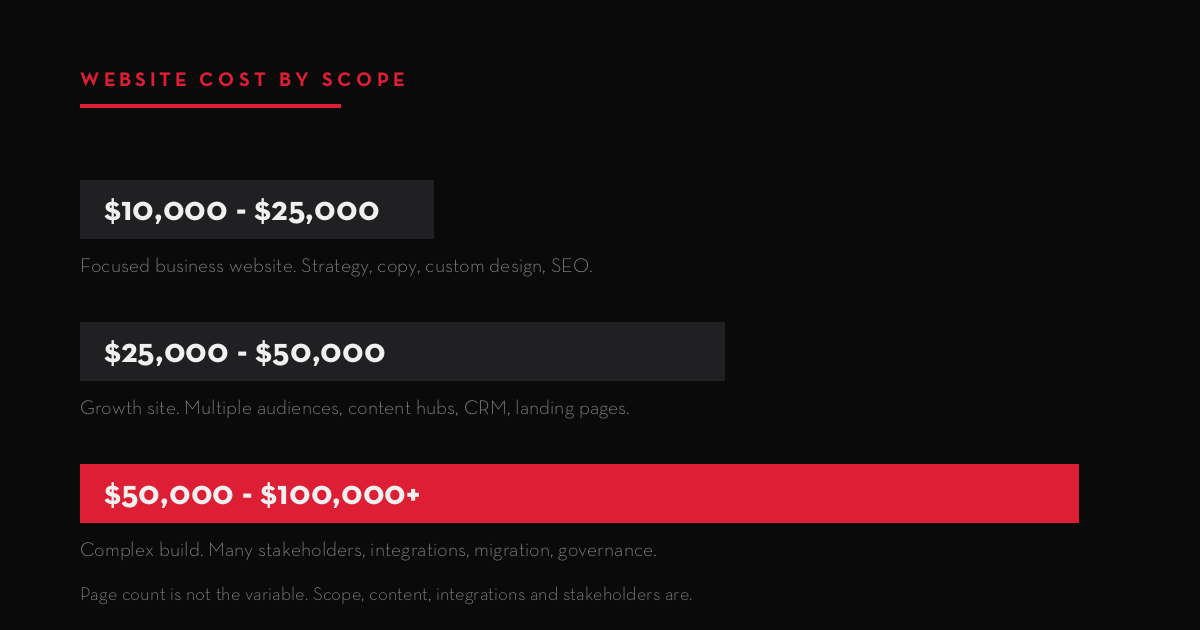
A focused business website may fall around $10,000 to $25,000. A more substantial growth-focused website with deeper strategy, content, search architecture and custom functionality may fall between $25,000 and $50,000 or more. Larger corporate, industrial, institutional, association, public-sector and highly customized projects can reach $50,000 to $100,000+, while complex digital platforms can extend considerably beyond that.
Those figures are more useful as planning ranges than as packages, because website cost tracks effort rather than page count, and page count alone tells us surprisingly little about the effort involved.
Two companies may each require a 20-page website. One may already have a clear brand, approved copy, photography, straightforward services and one decision-maker. The other may require stakeholder discovery, a new information architecture, original writing, multiple user journeys, search research, custom photography, data migration, CRM integration, accessibility planning, analytics, governance and several rounds of organizational approval.
The page count may be identical while the scope, complexity and commercial role of the two projects are entirely different.
A $10,000 to $25,000 Website: A Serious Business Asset
For many established small and mid-sized businesses, this is where professional website development begins to become strategically interesting.
At this level, website cost reflects far more than assembling attractive pages. The website needs to understand the business, communicate its value clearly and guide the right visitors toward action.
That may involve discovery and competitive research, website strategy, information architecture, professional copywriting, custom design, mobile user experience, search engine optimization, analytics, conversion planning, content management and the technical development required to bring the pieces together.
A professional services firm, construction company, specialized contractor, growing manufacturer or B2B company may fit comfortably within this range when its requirements are focused and the decision-making structure is relatively straightforward.
The resulting website should operate as part of the business itself, supporting the way the company is presented, discovered, evaluated and contacted.
Visitors should quickly understand what the company does, why it matters, who it serves and what to do next. Search engines should have a clear understanding of the company’s services and relevance. AI-powered discovery systems should encounter content with enough structure, context and authority to understand the organization and the subjects it knows well.
For a company using its website to win customers, attract employees, support advertising or strengthen its market position, those elements carry considerably more value than page count.
A $25,000 to $50,000 Website: Building for Growth
Website investment tends to rise as the website assumes more responsibility within the organization.
A growth-focused site may need to support several service categories, customer groups, geographic markets or stages of the buyer journey. It may include extensive original content, custom photography or video, advertising landing pages, resource libraries, case studies, search-driven content hubs, CRM connections, quote requests, booking functions, customer workflows or more sophisticated analytics.
This range is often especially relevant to companies operating in sectors where buying decisions are more complex and the website plays a larger role in establishing credibility before a conversation ever begins.
An engineering firm, manufacturer, technology company, energy services business, oil and gas supplier, commercial real estate group, developer or specialized professional services organization may need its website to support several audiences at once while also explaining technical capability, demonstrating experience, generating qualified inquiries and strengthening market authority.
In these environments, the website may influence procurement teams, executives, project managers, investors, prospective employees and other decision-makers, each of whom arrives with different questions and priorities.
This is also where information architecture and website strategy become especially important.
A company planning to compete for search visibility across Edmonton, Alberta, Canada or international markets benefits from a website built with that ambition in mind. Search strategy can shape the structure of the site from the beginning, allowing individual service pages, industry content, case studies, resources and geographic relevance to reinforce one another over time.
The same applies to answer engine optimization, or AEO. People increasingly discover companies and information through a combination of traditional search engines, AI-assisted search and conversational systems. Strong digital content therefore needs to establish subjects, expertise, relationships, locations, services and useful answers in language that both people and machines can understand.
That requires thoughtful writing, structure and authority. It also creates an important distinction between maintaining an online presence and deliberately building digital authority.
A $50,000 to $100,000+ Website: When Complexity Becomes the Project
Larger website budgets generally reflect larger responsibilities.
An engineering consultancy, industrial manufacturer, energy organization, oil and gas company, technology firm, real estate developer, commercial property group, association, municipality or established enterprise may have several audiences arriving at the same digital front door.
Customers may need one experience, job candidates another, investors another, members or stakeholders another, while internal teams may have their own publishing, governance and reporting requirements. The website has to organize all of that while keeping the experience clear and intuitive for the visitor.
Projects at this level may involve extensive research and discovery, stakeholder workshops, content audits, information architecture, UX planning, accessibility standards, original content development, migration of substantial existing content, custom development, integrations with business systems, advanced forms or databases, multilingual requirements, security considerations, testing and detailed launch planning.
In technical and industrial sectors, the site may also need to communicate complex capabilities, certifications, project experience, service territories, equipment, technical specifications or procurement requirements in a way that remains understandable to both technical and non-technical audiences.
For real estate and development organizations, the website may need to support property marketing, leasing, investor communications, project updates and portfolio visibility. For technology companies, the challenge may centre on explaining a sophisticated product clearly enough for buyers, partners and investors to understand its value while preserving the depth and credibility of the underlying technology.
Project management becomes a meaningful part of the work as well. A website involving leadership, marketing, operations, IT, legal, advertising, communications and outside vendors requires coordination. Decisions need to be documented, dependencies managed and hundreds of individual details carried from discovery through deployment.
This is why a $100,000 website and a $10,000 website can both represent excellent value. They are serving organizations with very different requirements, levels of complexity and commercial objectives.
Why Strategy Changes the Website Cost
Some of the most valuable website work happens before development begins.
A development team can build what has been requested. A strategic web team goes further by determining whether the requested structure, content and functionality represent the strongest approach for the business, its customers and its goals.
That work can include determining which audiences deserve priority, identifying opportunities within the existing digital presence, understanding competitors, mapping conversion paths, organizing information, evaluating search opportunities and deciding how the company should present itself in the market.
For an engineering company pursuing major projects, a manufacturer entering new markets, an oil and gas supplier competing for larger contracts or a commercial real estate group seeking investors or tenants, those decisions can carry significant commercial weight.
Good website strategy aligns the business objective, user experience, message, search opportunity, advertising strategy and technology before substantial development begins, giving the organization a stronger foundation for both launch and long-term growth.
Content Is Part of Website Development
One of the largest variables in website cost is also one of the easiest to underestimate: the content itself.
Writing a strong website involves considerably more than filling designated spaces with words. Professional website copy has to understand the customer, translate expertise into language people understand, establish differentiation, anticipate questions, support search visibility and move visitors toward meaningful next steps.
The demands become greater when a company operates in technical, regulated, specialized or highly competitive industries.
An engineering firm may need to explain technical capability to both expert and non-technical decision-makers. A manufacturer may need to turn equipment, processes and certifications into a compelling business case. An energy company may need to communicate scale, safety, capability and experience. A technology firm may need to make something complex feel immediately understandable. A developer may need to communicate opportunity to investors, tenants, partners and the public at the same time.
That is strategic writing, supported by a clear understanding of the business and the audience.
Photography, video, illustration, diagrams, case studies and other original assets can add another layer of production and can significantly improve credibility and communication when they are planned as part of the broader website experience.
This is why comparing website proposals solely according to the number of pages included rarely produces a useful website cost comparison. The quality of the thinking and content going onto those pages matters enormously.
SEO and AEO Should Influence the Website From the Beginning
A strong website in 2026 needs to be understandable to people, search engines and AI-powered discovery systems.
Search engine optimization remains fundamental. Technical health, Core Web Vitals performance, content quality, internal linking, page structure, local relevance and subject authority all contribute to how effectively a site can compete in search.
Answer engine optimization extends that thinking into the way information is structured and explained. A company hoping to become known for a particular subject needs enough high-quality information for digital systems to understand that relationship. Clear service pages, useful educational content, consistent terminology, meaningful geographic information, structured data where appropriate and well-organized answers all contribute to that digital footprint.
For an Edmonton company planning to grow beyond Edmonton, this becomes particularly important.
An Alberta engineering firm may want visibility for specialized services across Western Canada. A manufacturer may need to attract buyers across North America. An energy services company may compete across several provinces or international markets. A technology company may serve clients anywhere. A commercial real estate group may need both strong local relevance and broader investor visibility.
The website architecture needs to support those ambitions from the outset. Local search visibility and broader subject authority can reinforce one another when the structure, content and internal linking strategy are planned properly.
Your Website and Advertising Should Work Together
For companies actively investing in digital advertising, the website becomes part of the advertising system rather than a separate asset.
Paid search, programmatic advertising, social campaigns, retargeting, precision audience targeting and video advertising can all create attention and demand. The website then carries that momentum forward by helping the right visitor understand the offer, trust the organization and take the next step.
Campaign-specific landing pages, clear conversion paths, message continuity, analytics and audience measurement can significantly improve the value of paid media. This matters especially in industries with high-value customers, complex buying cycles or substantial contract values.
A manufacturer advertising to procurement leaders, an engineering firm reaching decision-makers within a specialized sector, an energy company entering a new market or a real estate developer promoting a commercial project may all benefit from tighter alignment between audience strategy, advertising and the website experience.
This is why website strategy and advertising strategy should inform one another. A website structured around the same audience insights, messages and commercial objectives as the advertising creates continuity from first impression through conversion and gives marketing teams better information about what happens along the way.
For organizations investing meaningfully in customer acquisition, that connection can be one of the most commercially important aspects of the website.
Integrations and Functionality Can Change the Budget Quickly
A website becomes more valuable as it becomes more connected to the way the organization operates.
CRM systems, ecommerce platforms, booking software, payment processing, member portals, inventory systems, directories, external databases, marketing automation, APIs and custom business logic can all transform a website from a marketing asset into part of the organization’s infrastructure.
That capability requires additional planning, development and testing because information has to move reliably between systems while the user experience remains simple.
What appears to the visitor as one straightforward form may connect to conditional logic, routing rules, customer records, automated communications, analytics and several connected platforms behind the scenes.
For larger B2B, industrial, technology and real estate organizations, integrations can become considerably more sophisticated, particularly when the website needs to interact with sales systems, client databases, project information, property listings, internal platforms or third-party software.
Website cost therefore reflects the system behind the screen as much as what appears on it.
So, How Much Should Your Company Budget for a Website?
For an established organization approaching a professional agency in Edmonton, $10,000 is a sensible starting point for a focused strategic website conversation, with investment increasing according to the depth of strategy, content, design, functionality, integrations, organizational complexity and project requirements.
Projects in the $25,000 to $50,000 range can support significantly deeper digital strategy and growth objectives. Projects reaching $50,000, $100,000 and beyond typically involve broader organizational requirements, sophisticated functionality, substantial content, multiple stakeholders or a website that performs a much larger role within the business.
The appropriate website cost is the one that matches the role the website needs to play in the organization.
A company earning millions of dollars, pursuing major contracts, recruiting specialized employees, entering new markets or competing across several regions has significant commercial value tied to its digital presence.
For an engineering consultancy, manufacturer, energy company, technology firm or commercial real estate organization, a single client, project, contract, tenant, investor relationship or strategic opportunity can materially exceed the cost of the website itself.
Seen through that lens, the website becomes part of how the market evaluates the company, how advertising converts, how prospects validate credibility and how opportunities move forward.
What Should Be Included in a Professional Website Proposal?
A useful website proposal should make the thinking behind the website cost clear.
Depending on the project, that may include discovery, research, strategy, UX, information architecture, design, copywriting, SEO and AEO planning, development, integrations, accessibility, analytics, content migration, advertising considerations, testing, launch support, hosting, website security and ongoing website support.
The exact combination should follow the needs of the organization. The strongest proposals explain both what will be built and why the recommended approach fits the business objective.
Is a $50,000 Website Worth It?
For the right organization, the economic argument can be straightforward.
Consider an engineering firm where one new project may be worth hundreds of thousands or millions of dollars. Consider a manufacturer pursuing major supply agreements, an oil and gas services company competing for long-term contracts, a technology company entering a new market or a real estate developer working with assets worth tens of millions.
In those situations, website cost is better measured against the opportunities the platform supports than against the number of pages produced.
The same principle applies to a $10,000 website. When the scope is appropriate and the finished site performs its role effectively, that investment can create substantial value for the organization.
Price becomes meaningful when it is connected to purpose.
Choosing a Web Design Company in Edmonton
When evaluating Edmonton web design companies, look beyond the visual portfolio and examine how the firm thinks.
How do they learn the business? How do they decide what belongs on the site? Who develops the messaging? How is search considered? How will advertising connect to the website? How will the architecture support future growth? Who manages the project? What happens after launch?
For businesses in engineering, manufacturing, energy, technology, real estate and other complex sectors, it is also worth considering whether the web team can understand the business well enough to translate specialized expertise into language that customers, investors, procurement teams and other stakeholders can act on.
Those questions reveal far more about the likely outcome than a website cost comparison built on page counts.
At Schif And The City, we approach website projects through the larger business and marketing picture. Strategy, messaging, search, advertising, creative, technology and the customer journey belong in the same conversation because the finished website has to bring all of them together.
We have worked with organizations that need focused business websites and organizations whose requirements call for complex, multi-stakeholder digital builds. The scale changes. The standard of thinking remains consistent.
Website Design and Development in Edmonton, Alberta
Schif And The City is an Edmonton-based marketing, advertising and digital firm serving businesses and organizations in Alberta, across Canada and beyond.
Our website design and development work can encompass digital strategy, UX and information architecture, professional copywriting, SEO and AEO, creative direction, design, development, advertising integration, hosting, website security, business-system integrations and ongoing support, with each engagement shaped around what the organization needs its digital presence to accomplish.
We work particularly well with organizations where the website has to do more than establish a presence, including engineering, manufacturing, energy, oil and gas, technology, commercial real estate, development, professional services and other complex B2B sectors where credibility, expertise, search authority and customer acquisition all matter.
Planning a Website That Needs to Contribute to the Business?
Your website investment should make sense for the business behind it.
If you are planning a strategic website project and want to understand the right scope, architecture, content, search strategy, advertising integration, technology and website cost, start the conversation with Schif And The City. Read more on the Schif And The City marketing blog.